 Genius Asian
 4 Factors Causing Various Different Lake Water & Sky Colors | 8K Video
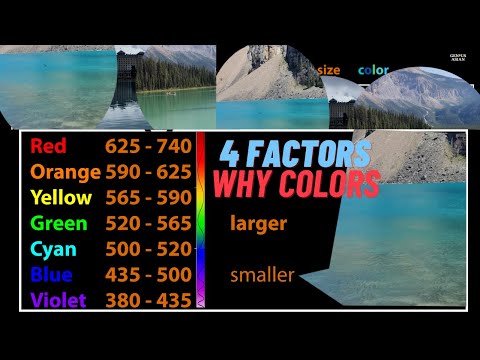
4 Factors Causing Various Lake Water and Sky Colors
Why are some lakes blue, others turquoise, and others green? In this video, Dr. David Zhang provides the detailed scientific explanation using four fundamental factors: absorption and three types of light scattering.
The Four Factors
Absorption: Different colors of light have different energies. Red light is absorbed first in shallow water, while deeper water absorbs all colors, appearing dark blue or black.
Rayleigh Scattering: When particles are much smaller than the light wavelength, shorter wavelengths (blue) scatter more. This is why the sky and clear water appear blue. Nobel Laureate Lord Rayleigh’s work explained this phenomenon.
Mie Scattering: When particles are about the same size as light wavelengths (dust, pollen, glacial rock flour), they scatter light differently, producing the turquoise and green colors seen in glacial lakes.
Non-Selective Scattering: When particles are much larger than light wavelengths, all colors scatter equally, producing white appearances like fog, clouds, and whitewater rapids.
Glacial Rock Flour
The stunning turquoise color of Canadian Rocky Mountain lakes comes from glacial rock flour — fine particles ground by glaciers from the bedrock. These particles, suspended in the water, scatter light through Mie scattering to produce the distinctive color that changes throughout the day and seasons.
For more travel and science content, check out Dubrovnik, Croatia and Sagrada Familia in Barcelona.
Understanding these phenomena helps you appreciate and photograph the natural world more effectively.
Alberta’s Lakes and Their Remarkable Colors
One of the big reasons people come to Alberta, Canada is to see the beautiful mountains and lakes. Some of the most visited lakes attract hundreds of thousands of visitors each year. What makes these lakes especially remarkable is that they display amazing hues of blues and greens — turquoise, emerald, and deep azure — colors vivid enough to stop any traveler in their tracks.
The color of the water is affected by the wavelength of the visible light spectrum reflected or absorbed by the chemical compounds in the water. The visible light spectrum consists of different colors with different wavelengths and energies. The shorter the wavelength, the higher the energy, and vice versa. Colors range from violet — the shortest wavelength and highest energy — through indigo, blue, green, yellow, and orange, to red, the longest wavelength and lowest energy.
How Glacial Rock Flour Drives the Color Spectrum
The chemical compounds that shift water color from blue to green are mainly related to the amount and size of glacial rock flour suspended in the water. Rock flour is the fine-grained sediment produced by the erosion of glaciers on the underlying bedrock.
The smaller the rock flour particles, the more they reflect blue light, giving the water a turquoise hue. The larger the particles, the more they reflect green light, producing a greenish tint. This happens because the amount of scattering depends on the ratio of the particle size to the wavelength of light.
The Three Types of Light Scattering
To understand why these lakes display such a spectrum of colors, it helps to look at the three primary types of light scattering based on particle size relative to light wavelength.
Rayleigh scattering occurs when particles are significantly smaller than the light’s wavelength. Nobel Laureate Lord Rayleigh’s groundbreaking work showed how pure water molecules scatter blue light, creating the azure hues seen in the sky and in clear water bodies.
Mie scattering occurs when particles are about the same size as the light’s wavelength. This is often seen in the haze caused by dust, pollen, smoke, or water vapor — and it is the primary mechanism behind the turquoise colors of glacial lakes.
Non-selective scattering occurs when particles are much larger than the wavelength. In this case, all wavelengths scatter almost equally. This is why water droplets and large dust particles cause fog and clouds to appear white.
The Role of Water Depth and Absorption
Depth plays a pivotal role in water coloration through the absorption of light. In shallower waters, the red end of the spectrum is absorbed entirely. In deeper water, all light tends to be absorbed, rendering the deep water a dark blue or near-black shade. Scuba divers witness these color shifts firsthand as they descend deeper underwater.
Other Minerals and Contributing Factors
Beyond rock flour and scattering, other minerals in the water contribute to the range of colors. When calcium carbonate precipitates out of water, it can create a cloudy or milky appearance due to tiny solid particles suspended in the water. This is especially common in areas with hard water, where the concentration of calcium and magnesium ions is high.
The differing shades seen across these lakes — from light blues to deep blues, turquoise, and emerald green — are due to different lakes having different proportions of rock flour mixed with different minerals. The amount of rock flour, the amount of other minerals, and the amount of algae present all combine to paint each lake its own distinctive color.