 Genius Asian
 Change various different types of wiper blades in under 30 seconds
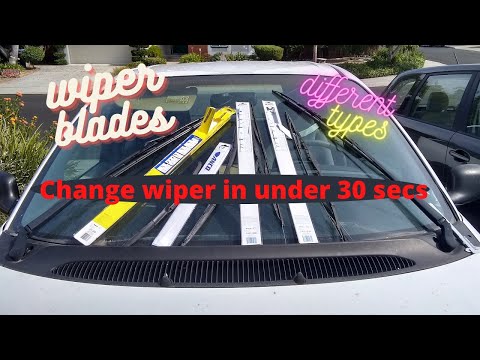
Change Various Different Types of Wiper Blades in Under 30 Seconds
Replacing wiper blades is one of the simplest car maintenance tasks, yet many people pay a shop to do it because the variety of blade attachment designs can be confusing. In this video, Dr. David Zhang examines 9 different cars spanning Japanese, American, and European makes to cover the most common wiper arm and blade designs. Once you learn the principles, you can figure out any design you encounter.
J-Hook Arms vs. Straight Arms
The two main categories of wiper arms are J-hook and straight. J-hook arms are the most common and have a curved hook at the end that clips into a slot on the blade assembly. Straight arms use a different attachment mechanism, typically a pin or button release.
Dr. Zhang demonstrates the removal and installation technique for each type, including tips for dealing with stuck blades and working with specific brands like Anco Series 31 and Series 14.
Key Tips
When replacing wiper blades, always support the wiper arm when the blade is removed. A bare wiper arm can snap back against the windshield and crack the glass. Where to find cheaper blades for the same brand names is also covered in the video, as auto parts stores often have significantly different pricing for identical products.
For the question of refilling just the rubber insert versus replacing the entire blade assembly, Dr. Zhang provides his assessment of when each approach makes sense.
For more car maintenance guides, see changing transmission fluid and windshield crack repair.
It does not take a genius to replace wiper blades. Anyone can do it in under 30 seconds once they understand the locking mechanism on their particular car.
Why Package Instructions Alone Will Get You Stuck
I’m the Genius Asian — welcome to the genius family. How do you change various different types of wiper blades in under 30 seconds? Once you have purchased a new wiper blade, you think you will be able to install it based on the instructions printed on the package, right? Wrong.
The new blade and the old blade could be different. One kind of blade may be designed to fit onto more than one type of wiper blade arm. And the instructions that come with the new blade probably only give rough guidance for how to put it on — they say nothing about how to remove the old blade.
Without knowing what you are doing, you may damage your blade or blade arm or the windshield because of difficulty removing the blade, or because you install it but fail to secure the mounting. A lot of that difficulty comes from the many different design variations. In this video we examine 9 different cars: Japanese-made, American, and European designs. Once you learn the principles through these examples, even if you encounter something you have never seen before, you can figure it out easily.
The wiper system has two components. One is the wiper blade arm, which stays on the car and is never removed. The other is the wiper blade itself, which is what gets replaced.
How J-Hook Blades Attach and Lock
The most common arm type is a J-hook — it looks like the letter J and has a hook shape. There are a few variations in length and width. Another frequently used arm type is a straight arm.
The J-shaped hook hugs an adapter on the blade. However, the blade may still come off because the J-hook does not lock to the blade automatically. Different designs use different ways to secure the blade to the hook.
On one common old-style blade, there is a large flap on the top. Push it down and when you hear the click, the blade can no longer move. To remove that blade, you first pry the flap open, move the blade toward the base of the arm so the blade is off the adapter, then move the blade in the opposite direction — away from the base of the arm — so the hook comes out of the blade assembly. For all J-hook mountings, you must always move the blade first in one direction, then in the opposite direction.
Installing Specific Blade Models — Anco Series 31 and Series 14
We bought an Anco Series 31 for $6 from Home Depot. Our car has a 9×3 J-hook. This design includes an extra adapter so that if you have a 9×4 J-hook you can still use it. If your car’s J-hook is the larger size, put the second adapter on top of the original one. We have a 9×3, so we do not need it.
How does this blade secure itself to the hook? There is a very small tab on the back. That tab goes into the hole on the J-hook to lock it. When you remove this blade later, you have to press that tab first. To install it, simply force the hook in.
We also bought the Anco Series 14 blade for $3 at Home Depot. Remove the adapter from the blade and you can see the mechanism more clearly. The plastic opening is narrower than the hook, with bumps at the end. The plastic is flexible enough that you can force the hook in, but once the hook is inside it can no longer come out. The narrow opening with bumps on either side secures the tip of the J-hook. When you install it, you may need to push pretty hard to hear the click that tells you it is secured.
There is also a tab on this blade that looks similar to the tab on the previous design. For a short J-hook, that tab does not reach the hole on the hook and does nothing. For a longer J-hook, it reaches the hole but still does not contribute much to latching. So the mechanism that holds it in place here is the narrow opening with bumps, not the tab. Since the blade was designed to fit different styles, some parts may not be relevant to your particular car — but it does not hurt to press the tab when removing it if you are unsure.
This blade also has a hole to support a pin-style mounting. If your car uses a side-lock pin instead of a J-hook, you can use this same blade.
A Third J-Hook Design and the Costco Blade
Here is another J-hook blade design. To install it, the hook has to go through the inside of the opening. A couple of bumps on each side provide friction so the hook does not move — these bumps secure the stem of the J-hook. To remove the blade, lift the lever to unlock it, then use the typical J-hook removal motion: move the blade toward the base of the arm, then in the opposite direction away from the base of the arm.
The J-hook blade from Costco works like this: to remove it, press the tab, because the tab goes into the hole on the J-hook for locking. To install it, move toward the base of the arm to let the hook in, then move away from the base of the arm so the tab snaps into the hole on the hook, locking it in place.
Knowing the exact locking mechanism may not be critical, because when you install a blade, the locking is usually automatic — you hear a click. When removing a blade, even if you do not press the tab or flap and you end up damaging the adapter, it may not matter because you are throwing away the old blade anyway. The J-hook itself is pretty thick and strong, so it is difficult to damage. What you do want to check first is whether the arm is a straight stick or a hook, because you need to move the two types in opposite directions. With a J-hook arm, start moving the blade toward the base of the arm. With a straight arm, start moving the blade away from the base of the arm.
Non-J-Hook Designs — Audi Q7, Tesla, and BMW
This is a wiper blade from an Audi Q7. Press the squared tab down with one hand and use the other hand to move the blade away from the base of the arm. To install it, just plug the blade back in — it is simply the reverse.
Note that on the Audi the wiper blade is tucked under the hood, so you cannot bend the wiper outward for easier access. Some people try to stop the wiper at a convenient position in the middle of the windshield. Some cars even have a procedure to place the wiper in replacement mode at the center of the windshield. However, the probability of scratching the center of the windshield is higher that way, and placing a cloth on the windshield to prevent scratches takes extra time. Since I want to replace the wiper in under 30 seconds, I work from its normal resting location — just lifting the blade a little bit. It can be a bit awkward, but it works.
Tesla also tucks its wipers under the hood. Again, you can use the service panel to raise the wiper higher, but that risks scratches on the center of the windshield. I just replace it without raising the blade. The removal is the same as the Audi: press the squared tab down with one hand and use the other hand to move the blade away from the base of the arm.
The BMW is another non-J-hook type. To remove the wiper blade, press the tabs on each side, then move the blade away from the base of the arm. To install it, do the reverse — just make sure it is aligned correctly at the top.
Buying Blades and the Refill vs. Replacement Question
Big stores such as Costco, Walmart, and Home Depot have high sales volume and can sell the same quality items at lower prices. I bought four wiper blades from Home Depot — three of them were less than $3 each and one was $6.
When ordering online, enter your car make and model to see compatible products. Even so, it is always a good idea to measure the length of your existing wipers to verify before you buy, because some cars use different lengths on the driver’s side and the passenger side. Our Subaru uses a 26-inch blade on the driver’s side and a 17-inch blade on the passenger side. Our Dodge Caravan uses two 28-inch blades of equal length. Measure and double-check, especially if you order from Costco, where you must provide the size yourself.
As an alternative to replacing the entire blade, you can refill just the rubber insert. The refill insert costs around $2, so it is cheaper — but because full blade sales have a higher volume, I got complete wiper blades for less than $3 from Home Depot. In other words, a refill may not save much money, and it certainly cannot be done in under 30 seconds or even 30 minutes. If the refill does not fit well and ends up scratching the windshield, it may cost a lot more in the end.