 Genius Asian
 Top 5 Must-See at Jasper: Maligne Lake & Canyon, Athabasca Falls, Medicine Lake & Jasper
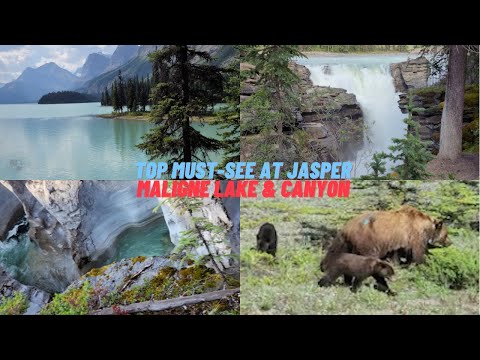
Top 5 Must-See at Jasper: Maligne Lake, Canyon, Athabasca Falls and More
Jasper National Park offers a quieter alternative to Banff with better wildlife viewing opportunities. In this video, Dr. David Zhang guides you through the five most visited sites around Jasper.
Maligne Lake and Spirit Island
The largest natural lake in the Canadian Rockies and the second largest glacier-fed lake in the world. Spirit Island, accessible only by tour boat, sits in dramatically colored emerald water that contrasts with the blue water at the docks. The color difference is due to varying concentrations of glacial rock flour.
Maligne Canyon
The deepest canyon in Jasper National Park, carved over millennia by water erosion to depths exceeding 50 meters. Much of the water originates from Medicine Lake through underground channels.
Athabasca Falls
While not particularly tall, these falls are renowned for their immense power as the Athabasca River cascades over hard quartzite into softer limestone, carving a fascinating narrow gorge.
Medicine Lake and Wildlife
Medicine Lake is part of the remarkable Maligne Valley watershed. The video captures a beaver sighting and a mother bear with cubs, along with elk and deer by the roadside. Jasper offers higher odds of bear encounters than Banff.
Jasper Town
The town provides a less crowded, more relaxed atmosphere compared to Banff, making it an excellent base for exploration.
For more travel guides, see Dubrovnik, Croatia and Carnival Breeze cruise ship.
Maligne Lake: Size, Access, and Spirit Island
Maligne Lake, in the heart of the Canadian Rockies, is the largest natural lake in the region and also the second largest glacier-fed lake in the world. It is a beautiful and pristine treasure in Jasper National Park in Alberta, Canada. Located a 44-kilometer drive south from the town of Jasper, the lake is accessible by car and shuttle bus, making it a welcoming destination for nature lovers.
Maligne Lake is renowned for its azure waters, encircling snow-capped peaks, three visible glaciers, and the spit of land known as Spirit Island. The bewitching blue waters might entice you to take a plunge, but make no mistake — the lake is glacier-fed and remains frigid year-round. We boarded a boat cruise to the picturesque Spirit Island, as it is not accessible by road or trail. Only tour boats or private, non-motorized craft can reach Spirit Island, which is actually not an island for most of the year. Only in spring, when the water level is higher from melting snow and heavy rains, is it likely to be disconnected from the mainland. Some of the best-known iconic photographs of the Canadian Rockies are of Spirit Island, surrounded by Maligne Lake, mountains, and the Cornet Glaciers in the background, and it remains one of the most stunning and photographed vistas of the Canadian Rockies.
The name Maligne is not just reserved for the lake. It is shared with Maligne River, Maligne Mountain, and Maligne Canyon, all derived from the French word for malignant, or wicked — a tribute to the awe-inspiring wild beauty of these places. Maligne Lake’s waters are both fed and drained by the Maligne River, flowing in near Mount Unwin to the south and exiting towards the north.
The Color Shift: Rock Flour and Glacier Science
As you embark on your cruise from the Maligne Lake docks, you may notice a magical transformation in the water’s hue. Nearing Spirit Island, the lake casts a vibrant emerald glow, a stark contrast to the mesmerizing blue waters at the journey’s start. This change is not just a whimsical play of nature but a marvelous scientific phenomenon. As you move further south, closer to the glaciers, the rock flour [?] within the water begins to settle. This results in a fascinating shift in color along the gradient from deep blue to emerald green. This phenomenon is enabled by the length of the lake, which is one of the longest in the Canadian Rocky Mountains, allowing the rock flour to settle gradually as the water flows from one end to the other.
The famed 44-kilometer Skyline Trail, a high-altitude multi-day hike, begins at Maligne Lake and concludes near the town of Jasper. Popular day excursions include the Opal Hills and Bald Hills Loops, each offering their own unique glimpses into the region’s splendors.
Maligne Canyon and Medicine Lake
Maligne Canyon, the deepest canyon in Jasper National Park, is a marvel of limestone carved over millennia by relentless water erosion, plunging over 50 meters deep at some points. Much of the water rushing through the canyon originates from Medicine Lake, located 14 kilometers away, traveling through an underground cave system before re-emerging. The ever-eroding canyon presents a narrative of time where the continuous swirling water gradually reshapes the rocky facade.
Medicine Lake, 20 kilometers southeast of Jasper Town, is part of the remarkable Maligne Valley watershed and is primarily glacier-fed. It is a geological marvel — not a typical lake, but rather a basin where the Maligne River backs up and eventually disappears underground.
Athabasca Falls
Mighty Athabasca Falls is another jewel of Jasper National Park, approximately 30 kilometers south of the town of Jasper. While not particularly tall, the falls are nonetheless renowned for their immense power and picturesque beauty as the Athabasca River cascades over hard quartzite into the softer limestone below, carving a fascinating narrow gorge.
Wildlife, the Town of Jasper, and Unexpected Encounters
The town of Jasper offers a respite from the crowds typically found in Banff, providing a better chance for wildlife encounters. While both parks boast elk, deer, bear, coyotes, and wolves, your odds of spotting a bear are higher in Jasper — as we discovered firsthand. A trip to Maligne Lake often comes with wildlife sightings. We were lucky enough to see a bear family — a mother with two cubs — making their way along a roadside. We also witnessed elk and deer roaming by the roadside, and a beaver at Medicine Lake.
At the Hulu [?] lookout, we ran into a couple of people working for the park service who were carrying skulls of bighorn sheep and mountain goats. We were allowed not only to touch them but also to give them a heft, and we discovered just how heavy a bighorn sheep skull was with those horns. One skull belonged to a male bighorn sheep — a sandy beige color — and the other to a male mountain goat, distinguished by its shaggy, bright white fur.
Along the road, we also got to see the wildlife overpasses that this region is famous for. There are also underpasses for wildlife, though we did not see those. We were told that sometimes you can spot wildlife while riding the gondola or walking along the boardwalk; we were not so fortunate in that respect, except for the many chipmunks scurrying around.